Monday, March 19, 2012

The Freshest of Fresh Fish -- Part 1

   Japan is all about fresh fish.  They pride themselves on it.  But this past weekend, here in Malaysia, I saw fish come out of the ocean and leave in the hands of buyers in less than an hour.  It was by far one of the most interesting of the outings organized by Spiral Synergy that I've joined. I was a part of a small but eager group of international expats. There must have been at least 3-4 languages being spoken in that van at any given moment. Most of us were motivated by the prospect of special photo ops as much as the thought of getting really fresh fish. In truth, it was a little too fresh for me!   I prefer my fish breaded or deep-fried, as opposed to flopping, clawing, writhing or otherwise dying in a plastic tub.  That's why Hubby prefers really good Japanese sushi or sashimi and I go for fish-and-chips, thank you!


         Anyway, we were whisked out of George Town, across the Penang Bridge and out to a little fishing village on the border between Penang and Kedah States.  It really was "the border," too. On one side of a small estuary was us; on the other were the folks of Kedah.  


      Starting around 10:00 a.m., the boats begin hitting the shore, zooming in quite quickly, one after another.  They're colorful and a bit bigger than you might imagine.  Immediately things start to happen.  No time is wasted between the boats arriving and getting those fish into the hands of the buyers,none at all!


         The fishermen start sorting the catch by type, flinging away any debris.  There are so many different types! There were grouper, big fat shrimp, manta rays, eel-like things, crabs and many more.  The one thing I didn't see was any kind of shellfish.    Maybe that's because this is net fishing, not trawling on the 
bottom where shellfish would be (I suppose.) But what do I know?  I was raised in America's Midwest, where most of us have never seen a fish still alive and breathing.


She wants fresh fish, she buys at boatside.


Beating the nets to knock off little fish
  
  While the sorting and selling is going on, men unfurl and beat the nets with sticks to knock the small fishies out of them so they won't stick, rot and stink.  Eager buyers, local women in headscarves and middle-man buyers with fistfuls of money, flock around to buy the fish directly off the boats.  And what happens to the rest?


I'll tell you about the really interesting part in the next blog post  (maybe tomorrow?)  -- coming soon to your very own computer!

Saturday, March 17, 2012

Things That Make Me Smile

Looking for hungry schoolkid customers
   Well, the charms of Penang have helped me overcome the loneliness of being "suddenly single" now that Hubby is off working in Japan. It's no fun living alone when you're used to daily companionship.  But there are so many wonder-ful things about Malaysia and Penang, it's hard to stay sad for long. 
     
     Last week I was dragging myself forlornly back home, sans husband, through the Kuala Lumpur airport at 4:30 a.m.  Some Indian Malaysian fellow was just doing his job, but he somehow seemed to detect that I needed cheeringup.  He just chattered away at me politely and kindly as I approached, passed him and moved on.  It was silly, inconsequential greetings.  But he'll never know how his sweet early-morning words encouraged me and welcomed me back to Malaysia!


    Even after a year (almost) of living here in Penang, I'm still entranced every day by ordinary things I see around me.  For example, that blue mobile snack shop pictured here.  Underneath all the empty-calorie fried snacks there's a motorbike and driver somewhere.  He plies his route every day after school, looking for hungry kids to buy his junk food.  The bags sometimes drag on the ground if he corners too sharply, but he doesn't seem to care.  I need to be as carefree about things in my own life, I reckon.


Lookin' for love in a car park!
   And how could anyone stay sad when even a car is batting its eyelashes at you?  Could the driver have parked any closer to that pillar?


   Even my coffee made eye contact with me this morning!  It was daring me to drink it up, and I did!


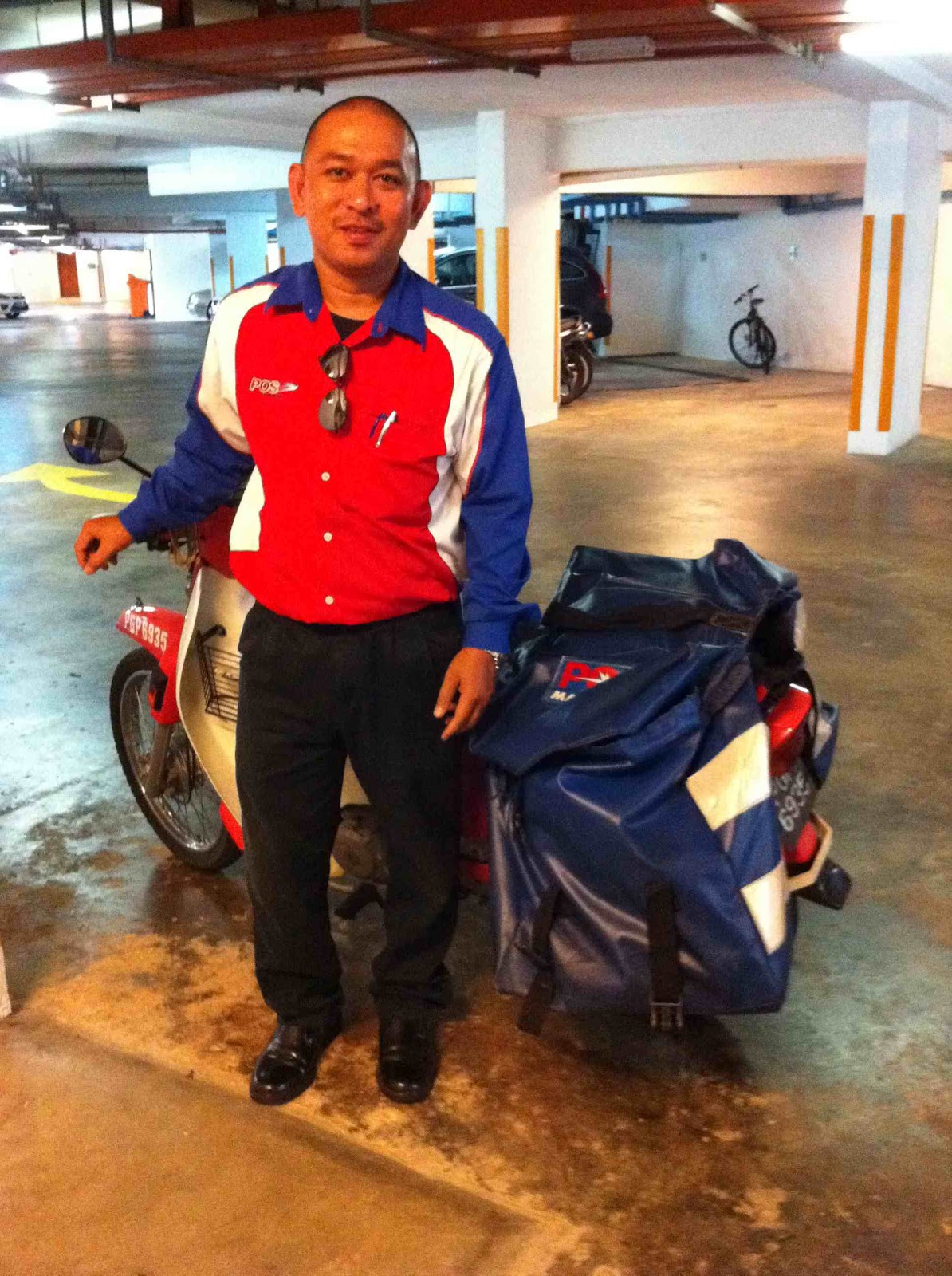
  There's someone else who smiles at me when our paths cross.  It's our postman. He would put more smiles on my face if he occasionally had a letter to put into my mailbox, rather than a bill.  So, if you're a friend of mine who's reading this, how about writing me a letter?

Monday, March 12, 2012

Forlorn Early-Morning Musings

I'm returning rather desolately to Penang after having gone to Japan to help Hubby settle into his new job as a Japanese salaryman, complete with a uniform jacket and company dorm rooom. This should be a good thing, right? Having a job offered in these troubled economic times. Returning to Japan, where the fish is fresh, things are organized and the people are quiet and polite. Knowing that all things will be taken care of properly by the highly paternalistic Japanese society. Hubby thankfully has no language barrier to contend with--his Japanese is good and can only get better now that he'll be the only foreigner working in this company.

So, what's the problem, you may well ask. It's that I don't live THERE, I live HERE, and until a few days ago, so did he. Oh, the guilt of my being retired and dwelling in a lovely resort-style condominium in sunny Penang, while my long-suffering-but-not-self-pitying husband lives in the suburbs of Tokyo, It just isn't right!

Although we're both well acculturated to Japan, having lived there for so long, certain things still manage to surprise. . . . Like having to get the company's approval for Hubby to purchase a table and chair with our own money. Why? Because in the company "apartment" (which would fit nicely into our Penang living room), the main room has tatami-mat flooring. So, we weren't allowed to buy this cute little table and chair we saw because the company needs to determine whether those furnishings would damage the tatami. We offered to buy one of those plastic mats that you put under office chairs to protect it. No way! Not without permission from higher-ups. So Hubby had to squeeze all of his computers, plus the TV, plus his dining stuff onto a little low table the size of a postage stamp. If necessary, he'll learn to live with it, but I don't think I could. In my scheme of things, people live in the MIDDLE THIRD of the space in a room, except for basketball players, who live in the UPPER THIRD. However, in Japan, you may WORK in the middle third, but you LIVE in the LOWER THIRD, which is to say "down on the tatami."

Anyway, I was reassured when I got see to Hubby's new workplace in a rural town northwest of Tokyo. It has a whole lot going for it -- much more than I'd expected. There are big supermarkets, home centers, and such. Some of our favorite family restaurants are there, too. I could survive, even thrive, there if I should wind up living back in Japan sometime in the future. I guess you can take the kids out of Japan (for a while), but you can't take Japan out of the kids!

Thursday, March 1, 2012

Chinese Clan Jetties Tour

God of Heaven in his finery
It's been a while since I posted anything  -- We've been "off-station," as they say when you've been out of Penang.  I guess that expression dates back to the days when there were plantations, or "stations" that people lived on.  Back in Guam, we used to say "off-island."  In the States we'd say "out of town."  But, I digress. . . . back to the Chinese clan jetties tour I want to write about (belatedly).


   A while back, the Chinese God of Heaven had his annual birthday.  The Chinese celebrate it with LOTS of food offerings, huge rods of incense, and noisy fireworks.  The ones in Penang who observe it the most fervently are the Chinese folks who live in clam groups on six jetties that extend into the sea.  (There used to be twelve of them, but unfortunately, developers have  pulled down six of them in an effort to make Penang look like Singapore, Hong Kong and such places that all look the same.)  


    Each jetty has a whole family group, a clan, living on it, and they all share the same name.  So, there's the Lim Jetty, the Chew Jetty and so on.  As I understand it, originally the clans were very poor Chinese people who came to Penang to work and had no money to buy land. So, they built their dwellings on piers extending into the sea.  Now they're a big tourist attraction  and they're very worth seeing.  So, when the God of Heaven's birthday celebration was taking place one night on the jetties, I went along to see what it was all about.  


What I'd expected to see
    I'd been expecting really humble homes, almost like shacks.  This was what I thought I'd see:
Inside a Clan Jetty Home
   
Front Gate of a Clan Jetty Home
      But wow -- I was so wrong!  These structures are real homes, complete with concrete floors and wood on top of it, long hallways with various rooms along them.  One even had a  fancy metal, lockable  gate to provide privacy or at least security.  Of course they don't have cars or car parking there, but they do have bicycle & motorcycle parking lots right here on the pier extending out in the water.  And there's garbage pick-up, too.  There's a temple at both ends of each jetty to keep evil spirits from entering by land or by sea.  They're like a little neighborhoods within a city.


    They say that each clan and its jetty has a different character.  I only saw two of them, but I think it must be true.  The first one I visited was full of hustle and bustle and enterprise.  Almost every home had someone outside selling something or other.  It seemed like a very prosperous, businesslike place.  The second one was quite different.  It was calm and peaceful, with people greeting our little group, asking where we were from and just being friendly.  Those families were very busy setting out food offerings for the god in front of their homes.  On the first jetty, the folks were taking their food to a huge table set up on the land in front of the jetties.  Different strokes for different folks, I guess!


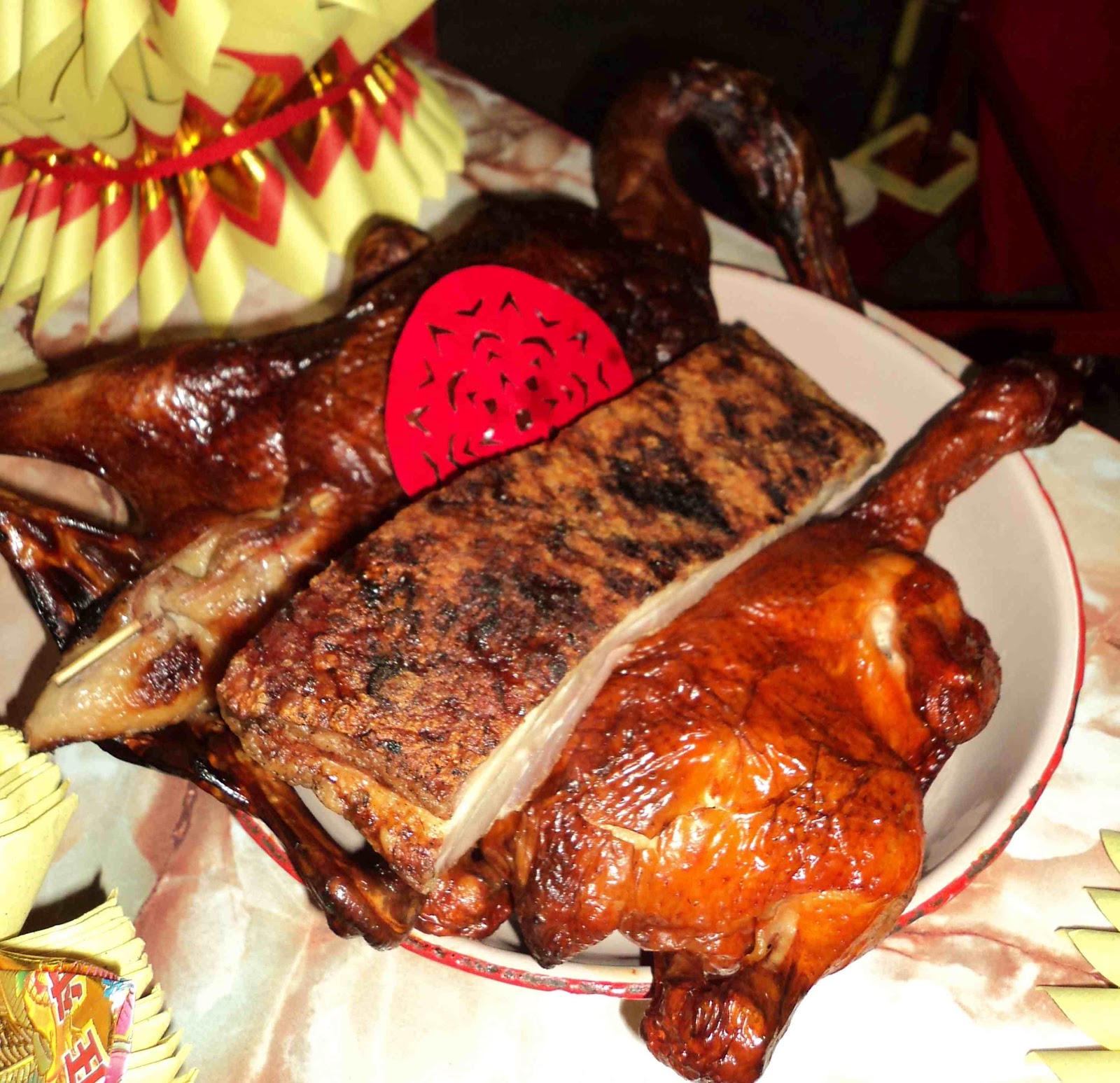
    There were many food items on the offering tables.  The fruits, especially oranges, had a red ribbon wrapped around each piece to indicate that they were meant as a gift to the God of Heaven.  (Though the people evidently eat the offerings themselves later on.)  Many families had laid out a whole roast pig.  Others had put out plates of the "three proteins" (pork, duck and chicken).  I've heard that the chicken and ducks are intact because having the head, tail and feet still on symbolizes completeness.  


 There was much, much more to tell about, but it'll have to wait until next year, I'm afraid.  There's just so much multi-cultural diversity in Malaysia, I think I'll never be able to learn it all.  But I'm going to try!


Saturday, February 4, 2012

The Sacred Cows of Kelawai Road

    
        Near our place there's a very busy street  called Kelawai Road.  It's the site of a massive construction project featuring two 43-story towers and a bunch of "lifestyle retail outlets."  But a mere half a block away, there's a scene so pastoral, you'd think you were out in the countryside.  

      I've always been curious about those cows.  One day, the owner  was there, tending to his herd.  Expertly dodging both steaming and dried-up cowpies, I made my way over to “interview” him. It went something like this:

            Me:  Hi.  Are these your cows?
            Him:  (Big smile.)  Yes, all of them.  (We counted together and determined that there were five.)
            Me:  Do you have any other cows?
            Him:  Yes.  (Mental counting.)  Thirty.  Over there.  (Broad gesture at some other place.)
            Me:  Are they for meat or milk?  (Stupid cultural mistake -- I’m talking to an Indian man who undoubtedly doesn't eat beef.) 
           
He forgave my ignorant mistake, and then we got onto a first-name basis, sort of.

            Him:  Does Auntie like milk?   (“Auntie” was me.  I never did get his name, more’s the pity.)  
            Me:  Yes, yes, she does.
            Him:  Where does Auntie live?  (My turn to gesture expansively in the direction of Pulau Tikus.)

     He was clearly considering providing me some cow’s milk, but we soon mutually decided not to go there, since the logistics of his delivering fresh milk to my doorstep seemed daunting.

            I asked if this was his land.  Nope – he didn’t know whose land it was.  I asked if it was OK for him to keep his livestock there.  He indicated that the  grazing keeps the grass down, so therefore it was OK for him to park his bovines there.  Next, I asked what he was feeding them.  He explained earnestly that the water had vitamins in it and the bagged feed was what I would call soy lees, the pulp byproduct of soymilk production.  Clearly, these animals are well-cared for and loved, or at least valued!  Two of them, the big black ones, are evidently "holy cows," related in some way to a local Hindu temple.  Maybe their milk goes there for ceremonies or maybe they pull ox carts for festivals. 

     I asked if they were “boys” or ‘girls,” something I suppose I could have ascertained simply by looking at their undercarriages.  But he kindly explained, “Boy, boy, girl, boy, girl.”  How old?  “Three years, two years, one-plus years, etc.”  He knew those animals’ ages better than some human fathers know those of their own offspring!

             Then we got to their names.  I asked if they had any, and no, they didn’t.  But then the owner brightened and suggested that “Auntie” could name them.  On the spur of the moment, I suggested “Blackie One, Blackie Two, Brownie One, Two and Three.”  (My seriously politically incorrect husband later suggested “Sirloin,” “T-Bone,” “Chuck,” Rump,” and “Rib-eye,” but that was tongue in cheek.) 

         Now you and I may well be the only foreigners who know the story of those "sacred cows."  Aren't we lucky?